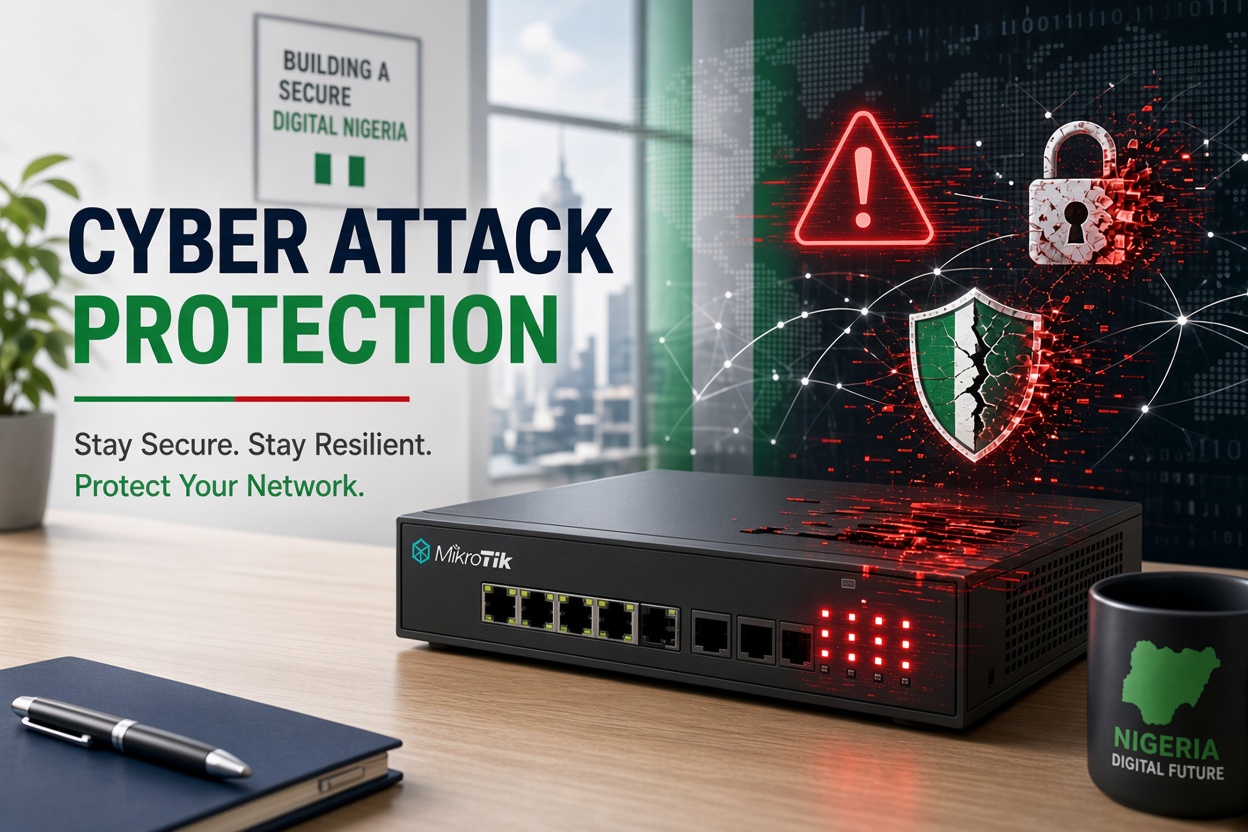
Many Nigerian companies — from small shops and cyber cafés to banks, hotels, schools, and large organisations — rely on MikroTik routers. These devices are popular because they are affordable, powerful, and widely available across the country.
Unfortunately, attackers are now actively targeting MikroTik routers that have their remote access (SSH) open to the internet. According to a recent warning from CERT Polska, hackers can take full control of these routers without needing any password.
The attacks have been happening since at least early September 2026. Once they gain control, attackers can:
- Steal data from networks and connected systems
- Redirect internet traffic to malicious destinations
- Spy on the network and monitor business communications
- Use the router for further attacks against other targets
- Disrupt business operations and cause costly downtime
This is especially dangerous in Nigeria, where many businesses leave management ports open for remote support or simply because the default settings were never properly secured.
Why This Matters to Nigerian Businesses
MikroTik is everywhere in Nigeria — from ISPs and offices in Lagos and Abuja to SMEs in smaller towns. A compromised router can lead to serious consequences:
| Business Risk | What It Means |
|---|---|
| Loss of Customer Data | Attackers can intercept or steal sensitive information flowing through your network. |
| Business Downtime | A hijacked or disrupted router can shut down internet access and halt daily operations. |
| Financial Fraud | Redirected traffic and network access can be used to enable payment fraud and account compromise. |
| Reputational Damage | Customers and partners lose trust when a breach is linked to weak network security. |
Even if your business is small, a hijacked router can be used as a gateway into bigger systems or turned into part of a larger attack network.
What You Should Do Immediately
Here are practical steps every Nigerian business using MikroTik should take:
- Update Your Router Immediately: Install the latest security updates from MikroTik. The fixed versions are RouterOS 6.49.21 or newer, RouterOS 7.23.5 (long-term), and RouterOS 7.24.2 or newer (stable).
- Close Unnecessary Internet Access: Do not leave SSH, Winbox, or web management open to the whole internet. Restrict access to only trusted IP addresses — for example, your office network or your IT support company’s IP.
- Check for Signs of Compromise: Look for unknown user accounts, strange scripts or scheduled tasks, unexpected configuration changes, and a “Flagged” status on the device.
- If You Suspect an Attack: Disconnect the router from the internet, save the current configuration and logs, reset to factory settings, rebuild the configuration carefully (do not restore a full backup from the compromised device), and change all passwords and keys.
- Build Long-term Protection Habits: Keep RouterOS updated, use strong unique passwords, enable firewall rules that block public access to management services, limit remote access to secure methods such as VPN, and regularly review who has access to your network equipment.
Final Advice
Cyber attacks targeting network equipment are increasing. For Nigerian businesses that depend on MikroTik, this is not a problem you can ignore. Taking action today — updating your devices and locking down remote access — can prevent serious damage tomorrow.
If you are not sure how to check or secure your MikroTik routers, contact a trusted IT professional or network engineer who understands these devices. Prevention is always cheaper than recovery.
Stay safe online.